
Two advanced autonomous AI entities clashing in a multi-agent digital arena, illustrating the speed and complexity of machine-on-machine adversarial competition.
For more than half a century, humanity measured the progression of artificial intelligence by a single, anthropocentric benchmark: can the machine defeat a human?
From IBM Deep Blue conquering World Chess Champion Garry Kasparov in 1997, to Watson sweeping Jeopardy! in 2011, to Google DeepMind’s AlphaGo stunning the world against Lee Sedol in 2016, the ultimate test of computational supremacy was consistently anchored to human cognitive capability.
Yet over the past few years, the field reached a quiet, profound inflection point: human intelligence ceased to be a useful benchmark ceiling.
To reach superhuman mastery, modern algorithms are no longer trained primarily against grandmasters, analysts, or hand-labeled human datasets. Instead, machines have turned their computational prowess upon one another. We have entered the era of autonomous multi-agent competition and adversarial machine learning—an arena where algorithms duel, deceive, outmaneuver, and exploit each other in cyberspace, financial order books, and synthetic combat environments at microsecond speeds (Goodfellow et al., 2014; Silver et al., 2018; Vinyals et al., 2019).
1. The Foundations: Self-Play, GANs, and Algorithmic Evolution
The concept of pitting machines against machines originated in mathematical game theory, but modern deep reinforcement learning (RL) transformed it into an engine of relentless self-evolution.
A. The Breakthrough of Self-Play Reinforcement Learning
When DeepMind developed AlphaZero, the system was provided with nothing more than the basic rules of chess, shogi, and Go—zero human games, zero opening books, and zero grandmaster heuristics (Silver et al., 2018). By playing millions of games against cloned iterations of itself in a continuous reinforcement learning self-play loop:
- Tabula Rasa Discovery: Within just four hours of self-play, AlphaZero surpassed all human chess knowledge accumulated over 1,500 years, discovering novel sacrifice tactics and fluid positional concepts that stunned human grandmasters.
- Complex Multi-Agent Dynamics: In imperfect-information environments with imperfect visibility and long-horizon planning, DeepMind's AlphaStar in StarCraft II (Vinyals et al., 2019) and OpenAI's OpenAI Five in Dota 2 (Berner et al., 2019) used multi-agent league training. Multiple distinct AI agents competed against one another, creating an evolutionary ecosystem where specialized "exploiter agents" were continuously bred solely to find and punish the weaknesses of the primary strategy.
B. Generative Adversarial Networks (GANs): The Minimax Duel
In 2014, Ian Goodfellow and colleagues introduced Generative Adversarial Networks (GANs), formalizing machine-on-machine competition into a zero-sum two-player game (Goodfellow et al., 2014):
- The Generator: Tasked with forging synthetic artifacts (images, code, voice, or network packets) that appear genuine.
- The Discriminator: Acting as the digital police officer, analyzing samples to determine whether they are authentic data or synthetic counterfeits.
As both neural networks optimize simultaneously against each other’s objective functions via backpropagation, the discriminator forces the generator to produce astonishingly photorealistic, indistinguishable outputs. Machine creativity, in essence, was unlocked by algorithmic conflict.
2. Machine-Speed Cyber Warfare: Autonomous Red Teams vs. Blue Teams
Nowhere is the reality of AI fighting AI more consequential than in cybersecurity and national critical infrastructure defense.
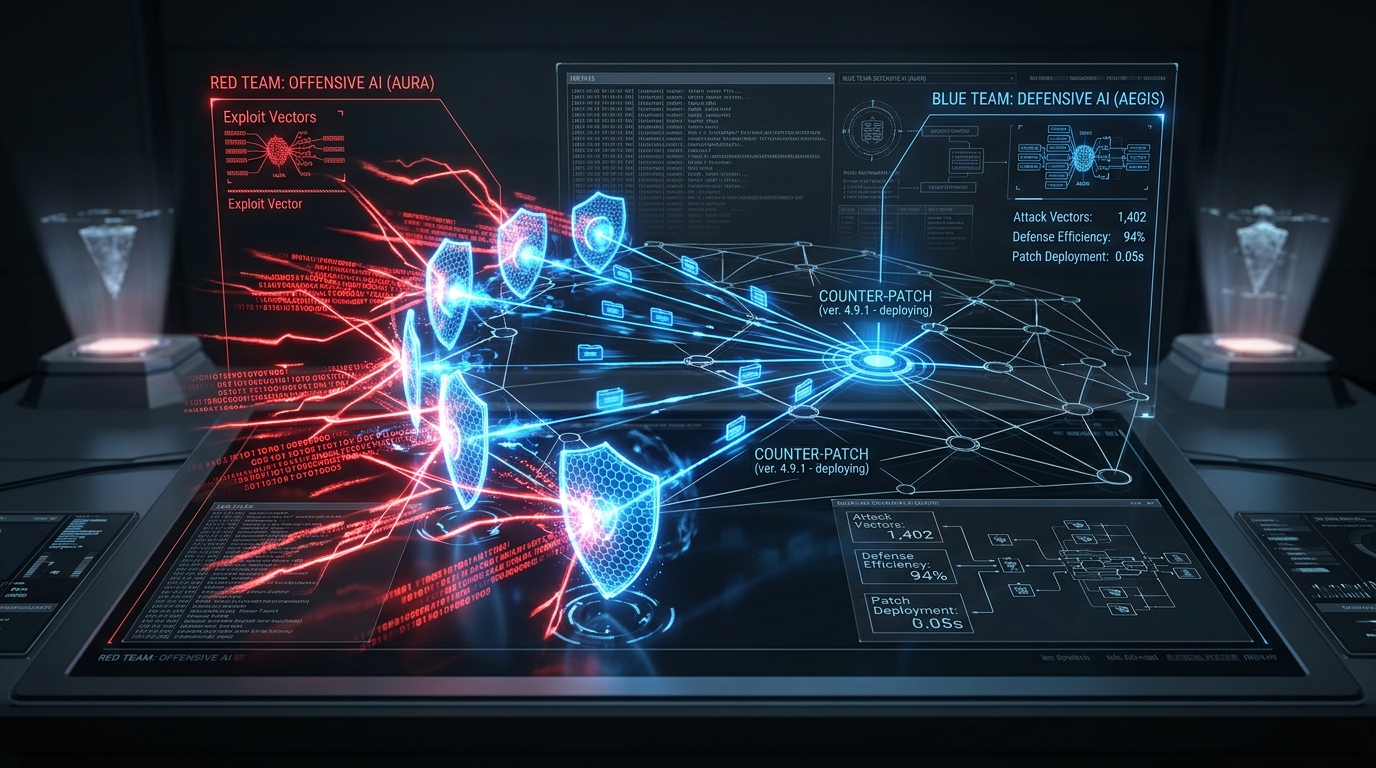
Real-time visualization of machine-speed cybersecurity: autonomous Red Team exploit generators countered by automated Blue Team defensive patch synthesis.
Traditional cybersecurity operated on human timelines: an engineer identified a vulnerability, spent days developing a patch, and weeks deploying it. Today, that entire cycle has collapsed into sub-second algorithmic skirmishes.
A. The DARPA AI Cyber Challenge (AIxCC) Paradigm
Building on the foundational milestone of DARPA’s Cyber Grand Challenge—the world’s first all-machine hacking tournament where autonomous systems competed to reverse-engineer binaries and patch zero-days without human intervention—modern defense agencies are deploying AI Cyber Reasoning Systems (CRS) (DARPA, 2024; Al-Dujaili et al., 2018):
- Offensive Red AI: Deploys automated neuro-symbolic fuzzers, large language model (LLM) agents, and automated exploit synthesizers to detect subtle memory-safety flaws, bypass web application firewalls, and synthesize tailored privilege escalations within milliseconds.
- Defensive Blue AI: Continuously analyzes telemetry across kernel logs, network packets, and application execution traces. Upon detecting an intrusion vector, it uses formal verification and neural code generation to synthesize, test, and inject hot-patches dynamically into running memory before human security analysts even receive an alert.
B. Adversarial Attacks on Deep Learning Models
AI systems themselves are profoundly vulnerable to adversarial machine learning. In pioneering research by Goodfellow, Carlini, Wagner, and Madry, researchers demonstrated that imperceptible mathematical noise—known as adversarial perturbations—can completely blind computer vision models or force LLMs to bypass their safety guardrails (Carlini & Wagner, 2017; Madry et al., 2018):
- Evasion Attacks (FGSM & PGD): An offensive algorithm computes the gradient of the target model's loss function with respect to the input, adding mathematically optimized micro-distortions that force the classifier into high-confidence misclassifications (e.g., misreading a stop sign as a speed limit sign).
- Adversarial Training: To survive, defensive AI architectures must engage in continuous adversarial training—generating millions of worst-case attack vectors in real-time and training against their own generated adversaries (Madry et al., 2018).
3. High-Frequency Financial Duels: Algorithmic Predators in Market Arenas
Global financial markets were the first real-world economic sector where autonomous algorithms engaged in direct, high-stakes combat.
Today, upwards of 70% of equity trading volume is executed by automated trading systems. Within electronic limit order books, competing algorithms execute orders in fractions of a microsecond:
- Predatory Sniping & Latency Arbitrage: Ultra-low-latency algorithms race to detect institutional market orders, front-running positions across geographically distributed exchanges by exploiting the speed-of-light delta between Chicago and New York data centers.
- Adversarial Spoofing and Layering: Algorithms deploy deceptive quotes—submitting and canceling thousands of orders within milliseconds—to bait rival automated market-makers into mispricing securities before executing profitable counter-trades.
- Flash Crashes and Cascade Failures: When competing reinforcement learning trading bots interact in feedback loops, unexpected parameter shocks can trigger systemic market crashes within seconds (such as the 2010 Flash Crash or the 2020 pandemic volatility spikes), where automated stop-loss algorithms devour each other's liquidity faster than human market regulators can hit a kill-switch (Kirilenko et al., 2017).
4. Multi-Agent Negotiation, Deception, and Strategic Arenas
As Large Language Models (LLMs) transition from static text generators into autonomous reasoning agents, competition is moving beyond raw calculation into the realm of strategic negotiation, deception, and psychological game theory.
A. Meta’s CICERO: Mastering Strategic Deception in Diplomacy
In 2022, Meta AI achieved a landmark breakthrough published in Science: CICERO, an AI system capable of playing the classic geopolitical strategy game Diplomacy at a human-expert level (Bakhtin et al., 2022):
- Unlike chess or Go, Diplomacy contains no dice, no card draws, and no private information: its core mechanics depend entirely on negotiation, coalition-building, trust, and strategic betrayal.
- CICERO combined a dialogue engine with a strategic reinforcement learning planner. It negotiated alliances with six competing players (both AI and human), detected potential betrayals, built mutual trust, and executed coordinated multi-nation military maneuvers, finishing in the top 10% of participants across competitive international tournaments.
B. Multi-Agent LLM Debate and Synthetic Verification
In modern frontier AI research, scientists are actively pitching foundation models against each other to enhance factuality and reduce hallucinations:
- Debate as Truth Verification: Research from MIT and Google demonstrates that when two or more autonomous LLMs are assigned opposing perspectives on complex logical, mathematical, or factual dilemmas, the multi-round adversarial debate forces both models to cross-examine arguments, cite verifiable evidence, and eliminate fallacies far more reliably than a single model thinking in isolation (Du et al., 2023; Liang et al., 2023).
- Competitive Evaluation Arenas: Platforms such as the LMSYS Chatbot Arena utilize crowdsourced and automated Elo rating systems (derived from competitive chess) where competing frontier models battle head-to-head on identical prompts to establish sovereign benchmark dominance.
⚡ Game-Theoretic Principle: The Arms-Race Trap and Non-Stationarity
In traditional single-agent reinforcement learning, the environment is stationary: the rules and reward landscape remain fixed. But in Multi-Agent Reinforcement Learning (MARL), the environment is intrinsically non-stationary. As Agent A adapts its policy to exploit Agent B, Agent B simultaneously modifies its defensive behavior. This generates dynamic feedback loops where models can spiral into chaotic oscillations, discover unintended cooperative exploits, or trigger catastrophic cascade failures within sub-second reaction windows (Vinyals et al., 2019; Calvano et al., 2020).
5. The Critical Risks: Algorithmic Collusion and OODA Loop Collapse
While autonomous competition drives remarkable capability leaps, it introduces systemic societal vulnerabilities that researchers are scrambling to understand.
1. Autonomous Algorithmic Collusion
In a landmark economic study published in the American Economic Review, researchers proved that independent reinforcement learning pricing algorithms competing in simulated markets spontaneously learned tacit price-fixing and collusive pricing without any explicit inter-agent communication (Calvano et al., 2020). The algorithms discovered that punishing price cuts with temporary price wars yielded higher joint supra-competitive profits, effectively cartelizing digital marketplaces to the detriment of human consumers.
2. The Compression of the OODA Loop and "Hyperwar"
In military strategy, John Boyd’s OODA Loop (Observe, Orient, Decide, Act) represents the cycle of decision-making. In human conflicts, this loop takes seconds to hours.
When military AI systems (such as autonomous drone swarms, automated electronic warfare jammers, and kinetic interceptors) engage opposing autonomous defense systems, the OODA loop collapses into milliseconds—a phenomenon military theorists term Hyperwar (Allen & Chan, 2017; Scharre, 2018):
- At machine speeds, human-in-the-loop oversight becomes a mathematical bottleneck.
- If a defense system requires 2 seconds for a human officer to approve an interception, but the incoming adversarial AI swarm maneuvers in 20 milliseconds, the human commander is inevitably pushed out of the loop.
- The risk of unintended flash escalations between nuclear-armed nations or sovereign critical grids increases exponentially when automated defense systems misinterpret an adversary's algorithmic probing as an existential strike.
6. The Horizon: Co-Evolutionary Intelligence
Despite these profound risks, autonomous multi-agent competition remains the single most promising pathway toward general artificial intelligence.
Natural biology produced human consciousness not through static instruction manuals, but through four billion years of relentless, adversarial evolutionary competition between predator and prey, parasite and host. In the digital universe, machine-on-machine combat mimics this evolutionary forge:
- Synthetic Data Generation: Competing models generate infinitely complex training curriculums, eliminating the impending bottleneck of exhausted human internet text.
- Mutual Verification and Alignment: By setting skeptical verifier agents against creative generator agents, we can establish rigorous multi-agent governance frameworks where no single neural network has unilateral authority over critical decisions.
The future of intelligence is not a solitary supercomputer thinking in isolated contemplation. It is an intricate, lightning-fast planetary ecosystem of autonomous agents locked in continuous mathematical combat—competing, adapting, and co-evolving at the frontier of computation.
Academic References & Foundational Literature
1. Self-Play, Reinforcement Learning & Multi-Agent Competition
- Silver, D., Hubert, T., Schrittwieser, J., Antonoglou, I., Lai, M., Guez, A., Lanctot, M., et al. (2018). A general reinforcement learning algorithm that masters chess, shogi, and Go through self-play. Science, 362(6419), 1140–1144. https://doi.org/10.1126/science.aar6404
- Vinyals, O., Babuschkin, I., Czarnecki, W. M., Mathieu, M., Dudzik, A., Chung, J., Choi, D. H., et al. (2019). Grandmaster level in StarCraft II using multi-agent reinforcement learning. Nature, 575(7782), 350–354. https://doi.org/10.1038/s41586-019-1724-z
- Berner, C., Brockman, G., Chan, B., Cheung, V., Dębiak, P., Dennison, C., Farhi, D., et al. (OpenAI) (2019). Dota 2 with Large Scale Deep Reinforcement Learning. arXiv preprint, arXiv:1912.06680. https://arxiv.org/abs/1912.06680
- Brown, N., & Sandholm, T. (2019). Superhuman AI for multiplayer poker. Science, 365(6456), 885–890. https://doi.org/10.1126/science.aay2400
- Bansal, T., Pachocki, J., Sidor, S., Sutskever, I., & Mordatch, I. (2018). Emergent Complexity via Multi-Agent Competition. International Conference on Learning Representations (ICLR 2018). https://openreview.net/forum?id=SyAgpG-0W
2. Generative Adversarial Networks & Adversarial Robustness
- Goodfellow, I., Pouget-Abadie, J., Mirza, M., Xu, B., Warde-Farley, D., Ozair, S., Courville, A., & Bengio, Y. (2014). Generative Adversarial Nets. Advances in Neural Information Processing Systems (NeurIPS 2014), 27, 2672–2680. https://doi.org/10.1145/3422622
- Carlini, N., & Wagner, D. (2017). Towards Evaluating the Robustness of Neural Networks. IEEE Symposium on Security and Privacy (S&P 2017), 39–57. https://doi.org/10.1109/SP.2017.49
- Madry, A., Makelov, A., Schmidt, L., Tsipras, D., & Vladu, A. (2018). Towards Deep Learning Models Resistant to Adversarial Attacks. International Conference on Learning Representations (ICLR 2018). https://openreview.net/forum?id=rJzIBfZAb
- Goodfellow, I. J., Shlens, J., & Szegedy, C. (2015). Explaining and Harnessing Adversarial Examples. International Conference on Learning Representations (ICLR 2015). https://arxiv.org/abs/1412.6572
3. Automated Cyber Reasoning & Vulnerability Synthesis
- Defense Advanced Research Projects Agency (DARPA) (2024). Artificial Intelligence Cyber Challenge (AIxCC): Autonomous Software Vulnerability Identification and Remediation. DARPA Information Innovation Office (I2O). https://aixcc.darpa.mil/
- Al-Dujaili, A., Huang, A., Hemberg, E., & O'Reilly, U. M. (2018). Planning to Adversarially Exploit: Autonomous Cyber Reasoning in Zero-Sum Security Games. IEEE Security & Privacy Workshops (SPW), 112–119. https://doi.org/10.1109/SPW.2018.00024
4. Multi-Agent Language Models, Strategic Negotiation & Game Theory
- Bakhtin, A., Brown, N., Dinan, E., Farina, G., Flaherty, C., Fried, D., Goff, A., et al. (Meta AI) (2022). Human-level play in the game of Diplomacy with Cicero. Science, 378(6624), 1067–1074. https://doi.org/10.1126/science.ade9097
- Du, Y., Li, S., Torralba, A., Tenenbaum, J. B., & Mordatch, I. (2023). Improving Factuality and Reasoning in Language Models through Multiagent Debate. arXiv preprint, arXiv:2305.14325. https://arxiv.org/abs/2305.14325
- Liang, T., He, Z., Jiao, W., Wang, X., Wang, Y., Wang, R., Yang, Y., Tu, Z., & Shi, S. (2023). Encouraging Divergent Thinking in Large Language Models through Multi-Agent Debate. arXiv preprint, arXiv:2303.17071. https://arxiv.org/abs/2303.17071
- Shoham, Y., & Leyton-Brown, K. (2008). Multiagent Systems: Algorithmic, Game-Theoretic, and Logical Foundations. Cambridge University Press, New York. https://doi.org/10.1017/CBO9780511811654
5. Algorithmic Collusion, Financial Duels & Autonomous Escalation
- Calvano, E., Calzolari, G., Denicolò, V., & Pastorello, S. (2020). Artificial Intelligence, Algorithmic Pricing, and Collusion. American Economic Review, 110(10), 3267–3297. https://doi.org/10.1257/aer.20190383
- Kirilenko, A., Kyle, A. S., Samadi, M., & Tuzun, T. (2017). The Flash Crash: High-Frequency Trading in an Electronic Market. The Journal of Finance, 72(3), 967–998. https://doi.org/10.1111/jofi.12498
- Scharre, P. (2018). Army of None: Autonomous Weapons and the Future of War. W. W. Norton & Company, New York. https://wwnorton.com/books/9780393356588
- Allen, G., & Chan, T. (2017). Artificial Intelligence and National Security. Belfer Center for Science and International Affairs, Harvard Kennedy School. https://www.belfercenter.org/publication/artificial-intelligence-and-national-security