
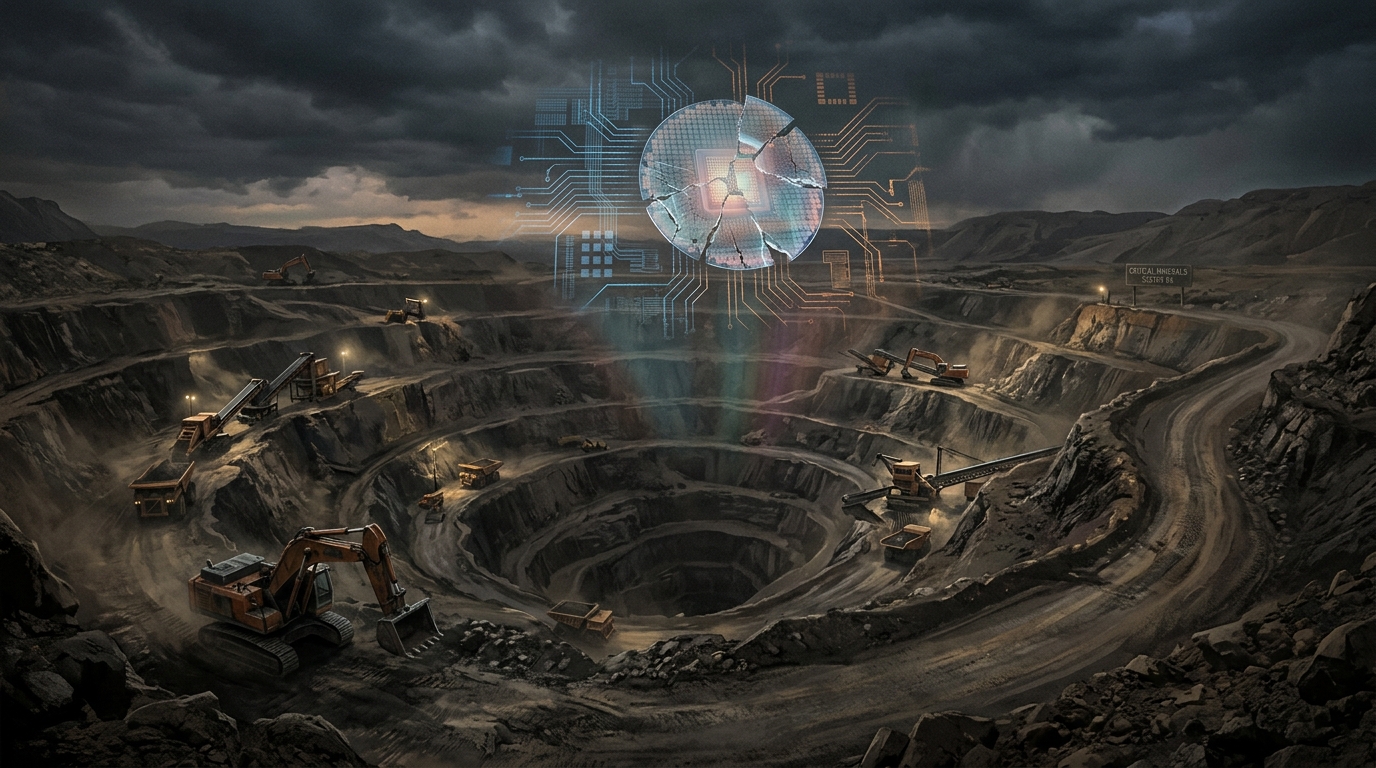
The physical reality of artificial intelligence: beneath every trillion-parameter model lies an industrial pyramid of open-pit extraction, fragile chemical refining, and contested mineral deposits.
In the prevailing apocalyptic imagination of Silicon Valley and popular science fiction, the existential threats of artificial intelligence are almost exclusively digital. We obsess over runaway recursive self-improvement, rogue autonomous drone swarms, black-box misalignment, or algorithmic hallucinations seizing control of financial markets.
Yet this techno-mythology rests on a seductive, dangerous illusion: that digital intelligence is weightless.
We describe artificial intelligence in ethereal metaphors—"the cloud," "cyberspace," "virtual nodes," and "neural weights." But intelligence is not ethereal. Artificial intelligence is an industrial product. Every generative prompt, every autonomous driving model, and every national defense supercomputer exists solely because of an astonishingly fragile, environmentally violent, and geographically concentrated terrestrial supply chain: the mining, chemical purification, and nanoscale fabrication of semiconductor minerals (Miller, 2022; Graedel et al., 2015).
As the global appetite for compute accelerates exponentially, the greatest threat to the future of AI may not be a software bug or a rogue algorithm. The ultimate bottleneck of the AI boom is physical exhaustion and kinetic war over the minerals required to build silicon hardware.
1. The Periodic Table of Artificial Intelligence: Elements of the Bottleneck
To understand why the AI revolution could grind to a catastrophic halt, one must step out of the computer science lab and into the open-pit quarry.
A single advanced semiconductor accelerator—such as an Nvidia Blackwell B200, an AMD Instinct MI300X, or a Google TPU—is arguably the most intricate physical object ever manufactured by human civilization. Etching billions of transistors onto a slice of silicon smaller than a postage stamp requires more than 60 distinct elemental materials, many of which are mined in only a handful of politically volatile jurisdictions (USGS, 2024; European Commission, 2023):
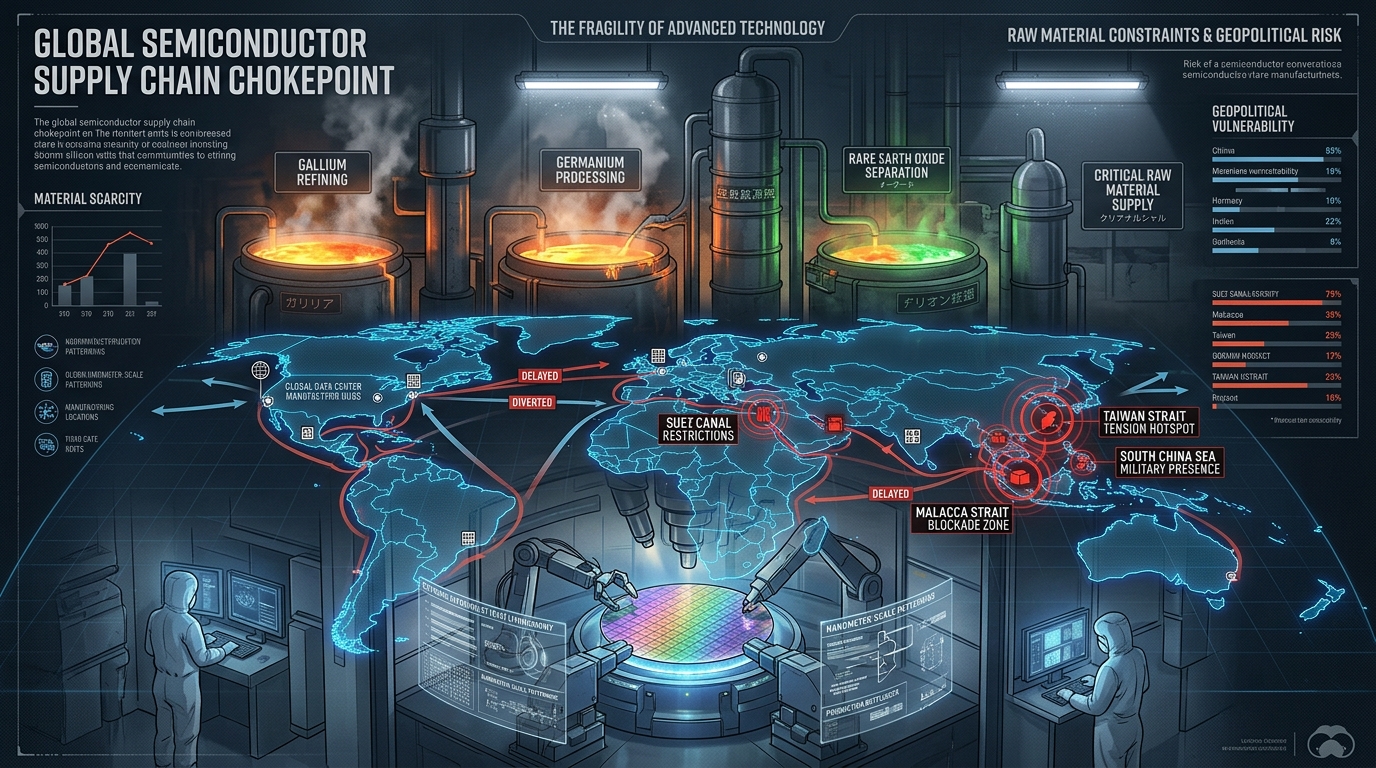
Global semiconductor supply chain chokepoints: chemical refining vats of critical mineral inputs, cleanroom lithography, and vulnerable maritime trade corridors.
A. The Irreplaceable Mineral Chokepoints
- Gallium and Germanium: Vital for high-speed optical interconnects, radio frequency (RF) chips, and specialized silicon-germanium (SiGe) substrates that link thousands of GPUs in hyperscale clusters. China currently controls over 80% of global gallium extraction and 60% of germanium production (USGS, 2024). In 2023 and 2024, Beijing demonstrated the power of this leverage by imposing strict export licensing on both elements.
- Ultra-High-Purity Quartz (HPQ): Monocrystalline silicon ingots cannot be grown without crucibles made of quartz that is 99.999% pure silica ($SiO_2$). Virtually the entire global supply of semiconductor-grade quartz comes from a single geological anomaly: the pegmatite mines of Spruce Pine, North Carolina. When Hurricane Helene battered the region in late 2024, it briefly paralyzed operations, reminding the global tech industry that the entire AI economy rests on a single Appalachian valley (Miller, 2022).
- Semiconductor Gases (Neon, Krypton, Xenon): Excimer lasers used in Deep Ultraviolet (DUV) and Extreme Ultraviolet (EUV) photolithography require ultra-pure noble gases. Prior to 2022, over 50% of the world’s semiconductor-grade neon was refined as a steelmaking byproduct in Mariupol and Odesa, Ukraine. The Russian invasion instantly wiped out these facilities, driving neon spot prices up by over 600% within weeks.
- Rare Earth Elements (Dysprosium, Neodymium, Terbium): Essential for the ultra-precise magnetic linear motors that position lithography mirrors with sub-nanometer accuracy inside ASML machines, as well as high-density storage drives and actuators (Klinger, 2017).
- Antimony and Tantalum: Antimony is indispensable for advanced infrared sensors, military optics, and semiconductor doping, while tantalum powers micro-capacitors inside high-density power delivery boards. Both are subject to severe geopolitical instability in Central Africa and Eurasian supply corridors.
2. The Fragility of Fabrication: A Monoculture on the Brink
Even if raw mineral ores are successfully hauled out of the ground, the industrial infrastructure required to refine them and etch microchips is frighteningly centralized.
Consider the compounding chokepoints that form the modern semiconductor pyramid:
- The Lithography Monopoly: A single Dutch company, ASML, holds a 100% global monopoly on the production of Extreme Ultraviolet (EUV) lithography machines. Each EUV machine costs over $350 million, weighs 180 metric tons, and contains more than 100,000 custom components sourced from over 5,000 specialized suppliers worldwide.
- The Foundry Concentrator: Over 90% of the world's most advanced sub-5nm AI processors are fabricated on a single island: Taiwan, primarily by the Taiwan Semiconductor Manufacturing Company (TSMC) (Allison, 2021). Taiwan lies just 100 miles across a contested strait from the world’s second-largest superpower.
- Chemical Refining Monopolies: While mining occurs globally, chemical separation and purification—often involving toxic hydrofluoric acids and hazardous waste that Western environmental regulations heavily restrict—are overwhelmingly concentrated in China.
"You can write the most brilliant algorithmic architecture in history, but if a warship blockades a 100-mile strait or a refinery cuts off high-purity gallium, your artificial intelligence ceases to exist."
3. From Trade Restrictions to Kinetic Resource Wars
For the past decade, competition over semiconductors was waged through regulatory diplomacy: export controls, tariffs, corporate blacklists, and the US CHIPS Act. But we are rapidly approaching the limits of economic diplomacy.
As artificial intelligence is recognized as the foundational technology of national power—governing military autonomous drones, quantum cryptographic decryption, economic planning, and intelligence synthesis—the imperative to secure semiconductor minerals is shifting from commercial competition to existential national security doctrine (Allison, 2021; Bazilian & Sovacool, 2021).
⚠️ The Mineral Depletion Trap and Kinetic Escalation
Academic literature in resource economics identifies the mineral depletion trap: as ore grades deteriorate and capital costs soar, access to remaining Tier-1 deposits becomes a zero-sum geopolitical struggle (Bardi, 2014). In high-tech semiconductors, where substitution is physically constrained by quantum mechanics, nations facing strategic chip blockades are economically and militarily incentivized to deploy kinetic force to break supply embargoes or annex sovereign mineral territories (Bazilian & Sovacool, 2021).
Flashpoints for Kinetic Semiconductor Resource Wars:
- The Taiwan Strait and the South China Sea: A naval blockade or military confrontation over Taiwan would immediately wipe out more than half of the world's computing production capacity, inflicting an estimated $10 trillion blow to the global economy and instantly freezing the production of all frontier AI accelerators.
- Deep-Sea Mining Scrambles (The Clarion-Clipperton Zone): As terrestrial deposits dwindle, superpowers are dispatching naval-backed exploration fleets to harvest seabed polymetallic nodules containing cobalt, nickel, and rare earths from the Pacific Ocean floor, triggering bitter legal, territorial, and military standoffs over international seabed sovereignty (Levin et al., 2020).
- Central Africa and the Andes: The scramble for lithium, copper, and coltan in politically unstable corridors across the Democratic Republic of the Congo and the South American Lithium Triangle has already fostered covert paramilitary conflicts, mercenary intervention, and state-backed extraction monopolies.
4. The "Great Silicon Freeze": How the AI Boom Actually Dies
What happens if a major resource war breaks out, or critical mineral supply lines are severed by prolonged blockades? The collapse of the AI boom would not look like an algorithmic crash; it would look like rapid physical obsolescence.
A. The Hardware Decay Crisis
High-performance AI accelerators do not last forever. GPUs operating at full throttle in high-density data centers under relentless thermal stress have an average Mean Time Between Failures (MTBF) of 2 to 4 years. In massive clusters containing 100,000 GPUs, individual chips fail daily and must be continuously replaced.
If the global pipeline of replacement silicon is severed:
- Cluster Cannibalization: Cloud providers would be forced to cannibalize existing server racks to keep core infrastructure online.
- The Halting of Frontier Training Runs: Training the next generation of frontier models (requiring clusters of 500,000+ next-gen accelerators) becomes physically impossible. AI capability plateaus abruptly.
- Severe Compute Rationing: As available compute depreciates, cloud costs would skyrocket by 1,000% or more. Commercial AI startups, public APIs, and civilian research labs would go bankrupt overnight. Compute would be nationalized and strictly rationed by state militaries and intelligence agencies.
B. The Illusion of Recycling and Substitution
Tech evangelists often argue that when minerals run short, human ingenuity will simply substitute alternative materials or recycle old electronics. But materials science tells a harsher truth:
- Thermodynamic Limits: You cannot simply "swap out" copper or gallium. Gallium nitride ($GaN$) and silicon carbide ($SiC$) possess unique electron mobility and wide-bandgap physical properties defined by quantum physics (Graedel et al., 2015). Alternative elements either generate catastrophic thermal dissipation or cannot physically operate at nanometer scales.
- The Recycling Mirage: Modern microchips are marvels of atomic integration, with infinitesimal layers of dozens of elements fused into microscopic silicon matrices. Less than 1% of rare earths and specialty semiconductor metals are currently recycled globally because the chemical and energy cost of extracting microscopic trace elements from e-waste exceeds the cost of digging new ore from the earth.
5. Escaping the Chokepoint: What Can Humanity Do?
If artificial intelligence is to survive as a permanent pillar of human civilization rather than a fleeting historical flare-up, global policymakers and computer scientists must fundamentally re-engineer the material foundation of computing:
- Decoupling AI Scaling from Pure Brute-Force Hardware: The current dominant paradigm—training ever-larger models with billions of parameters on brute-force GPU clusters—is materially unsustainable. Research must shift toward neuromorphic architectures, radical algorithmic efficiency, and biological computing that achieve intelligence with milliwatts rather than megawatts of silicon.
- Diplomatic Treaties on Critical Mineral Non-Proliferation: Critical semiconductor minerals must be afforded protected status under international law, akin to maritime freedom-of-navigation principles. Weaponizing mineral embargoes inevitably creates a self-fulfilling escalation toward kinetic war.
- Closed-Loop Metallurgical Refining: Investing billions into domestic, environmentally contained chemical refining technology to break single-nation refining monopolies without triggering ecological sacrifice zones.
- Strategic Global Mineral Reserves: Nation-states must build strategic physical stockpiles not merely of crude oil, but of purified gallium, germanium, high-purity quartz, and semiconductor-grade noble gases to buffer against geopolitical shocks.
Conclusion: The Earth Always Wins
The ultimate irony of the digital age is that the most abstract invention in human history—artificial intelligence—is utterly bound to the most primitive activity in human history: digging rocks out of the dirt.
Silicon Valley envisioned a transcendent future where humanity uploaded its mind into the heavens of cyberspace, forgetting that cyberspace is made of pulverized quartz from North Carolina, gallium refined in Sichuan, cobalt dredged from Congolese mud, and neon collected from the blast furnaces of devastated Ukrainian steel mills.
If nations continue on the current trajectory of zero-sum technological chauvinism, weaponized export controls, and territorial aggression, the AI revolution will not end with a philosophical bang or a superintelligent uprising.
It will end with silent, empty cleanrooms, rusted excavators in contested mines, and the cold realization that human hubris cannot out-compute the periodic table of elements.
Academic & Strategic References
1. Semiconductor Geopolitics & Supply Chain Vulnerabilities
- Miller, C. (2022). Chip War: The Fight for the World's Most Critical Technology. Scribner / Simon & Schuster, New York. https://www.simonandschuster.com/books/Chip-War/Chris-Miller/9781982172008
- Allison, G. (2021). The Great Tech Rivalry: China vs the U.S. in Semiconductors, Artificial Intelligence, and 5G. Belfer Center for Science and International Affairs, Harvard Kennedy School. https://www.belfercenter.org/publication/great-tech-rivalry-china-vs-us
- European Commission (2023). Study on the Critical Raw Materials for the EU 2023: Final Report. Directorate-General for Internal Market, Industry, Entrepreneurship and SMEs, Brussels. https://ec.europa.eu/
2. Mineral Depletion, Criticality & Material Science Constraints
- Graedel, T. E., Harper, E. M., Nassar, N. T., Nuss, P., & Reck, B. K. (2015). Criticality of metals and metalloids in high-technology economies. Proceedings of the National Academy of Sciences (PNAS), 112(14), 4257–4262. https://doi.org/10.1073/pnas.1500415112
- Bardi, U. (2014). The mineral depletion trap for high-technology transitions. Nature Materials, 13(4), 323–327. https://doi.org/10.1038/nmat3831
- United States Geological Survey (USGS) (2024). Mineral Commodity Summaries 2024: Gallium, Germanium, Rare Earths, Quartz, and Antimony. U.S. Department of the Interior, Reston, Virginia. https://pubs.usgs.gov/periodicals/mcs2024/mcs2024.pdf
- International Energy Agency (IEA) (2023). Critical Minerals Market Review 2023: Navigating Supply Risks in Strategic Technologies. IEA Reports, Paris. https://www.iea.org/reports/critical-minerals-market-review-2023
3. Resource Warfare, Deep-Sea Frontiers & Geopolitical Escalation
- Bazilian, M. D., & Sovacool, B. K. (2021). The defence and national security implications of mineral security and high-tech supply chains. Science, 373(6561), 1301–1304. https://doi.org/10.1126/science.abf5860
- Klinger, J. M. (2017). Rare Earth Frontiers: From Terrestrial Subsoils to Lunar Landscapes. Cornell University Press, Ithaca, New York. https://doi.org/10.1353/book.56475
- Levin, L. A., Amon, D. J., & Lily, H. (2020). Challenges to the sustainability of deep-seabed mining for critical high-technology minerals. Marine Policy, 122, 104109. https://doi.org/10.1016/j.marpol.2020.104109
- Scharre, P. (2021). The semiconductor supply chain and the geopolitical battle for AI supremacy. Center for a New American Security (CNAS), Technology and National Security Program. https://www.cnas.org/