
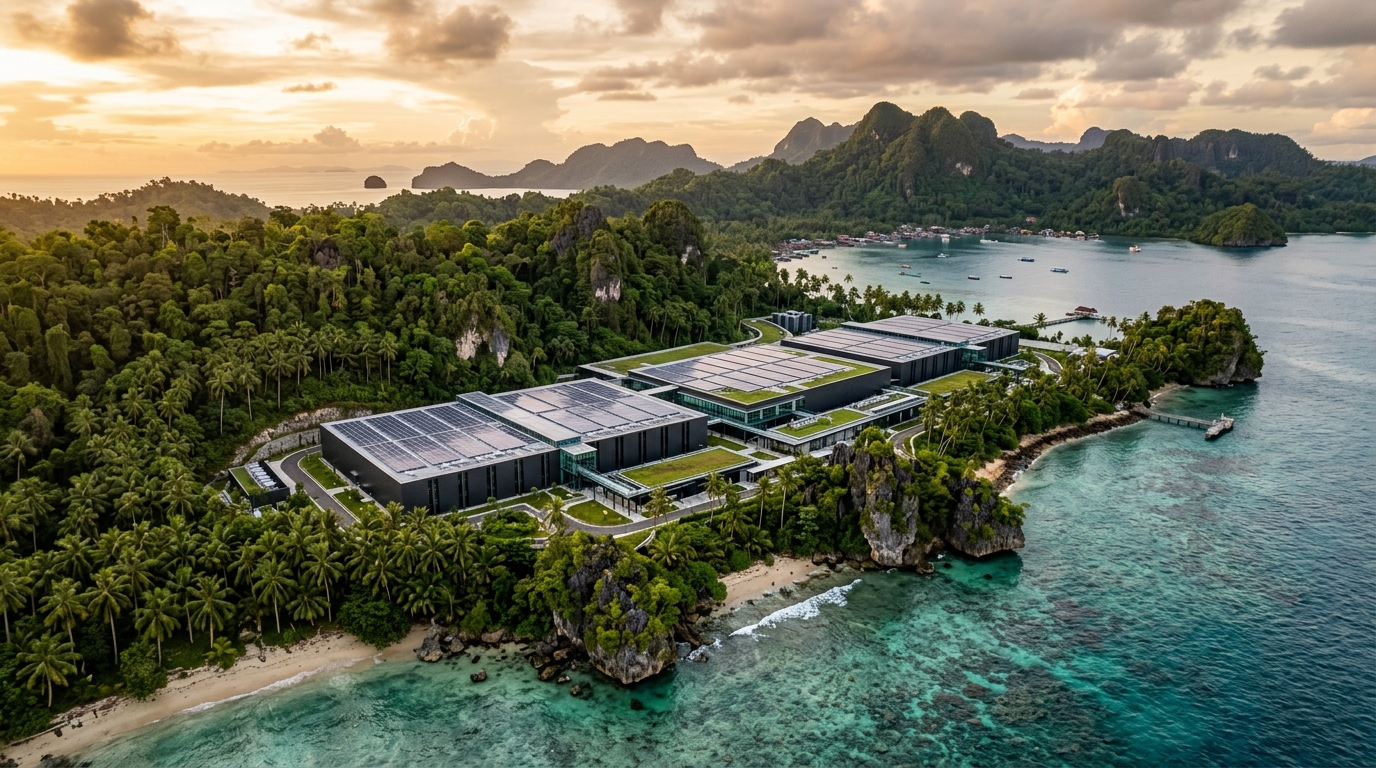
Hyperscale data center complex envisioned on an Indonesian tropical island coastline, balancing compute infrastructure with surrounding marine ecology.
The global explosion of artificial intelligence, high-performance computing, and cloud services has triggered an unprecedented construction boom in digital infrastructure. Yet behind every generative AI prompt, cloud backup, and algorithmic model lies an invisible industrial giant: the modern hyperscale data center.
Once tucked away inconspicuously in suburban business parks, today's data center campuses have evolved into colossal computing complexes. Operating hundreds of thousands of high-density GPU and CPU servers 24 hours a day, these facilities demand vast quantities of electricity, consume millions of liters of freshwater for cooling, and discharge substantial heat and emissions into surrounding ecosystems (Masanet et al., 2020; de Vries, 2023).
As tech hubs across the globe face mounting public pushback and environmental limits, a fascinating geopolitical and environmental experiment is unfolding in Southeast Asia: Indonesia is moving to lease and designate entire islands to host international data centers.
1. The Growing Environmental Footprint of Modern Data Centers
The modern digital economy often projects an aura of weightless, clean virtuality. In reality, peer-reviewed life-cycle assessments confirm that data centers are among the most resource-intensive industrial facilities on Earth (Siddik et al., 2021).
A. Voracious Energy Consumption and Carbon Emissions
The computational density required by modern AI architectures—such as high-density GPU clusters running transformer models—has skyrocketed per-rack power requirements from 5–10 kW a decade ago to upwards of 40–100 kW per rack today (de Vries, 2023; Patterson et al., 2021).
- City-Scale Power Demand: A single modern 100-megawatt (MW) hyperscale campus can consume as much electricity as a city of 80,000 households. Globally, the International Energy Agency estimates data centers, AI, and crypto-mining could double their worldwide electricity consumption by 2026, reaching over 1,000 TWh (IEA, 2024).
- Grid Strain & Fossil Fuel Lock-in: In regions where clean energy infrastructure lags behind compute demand, tech operators frequently fall back on fossil-fuel peaker plants or long-term natural gas and coal contracts, offsetting corporate decarbonization pledges and locking in long-term emissions (Luccioni et al., 2023).
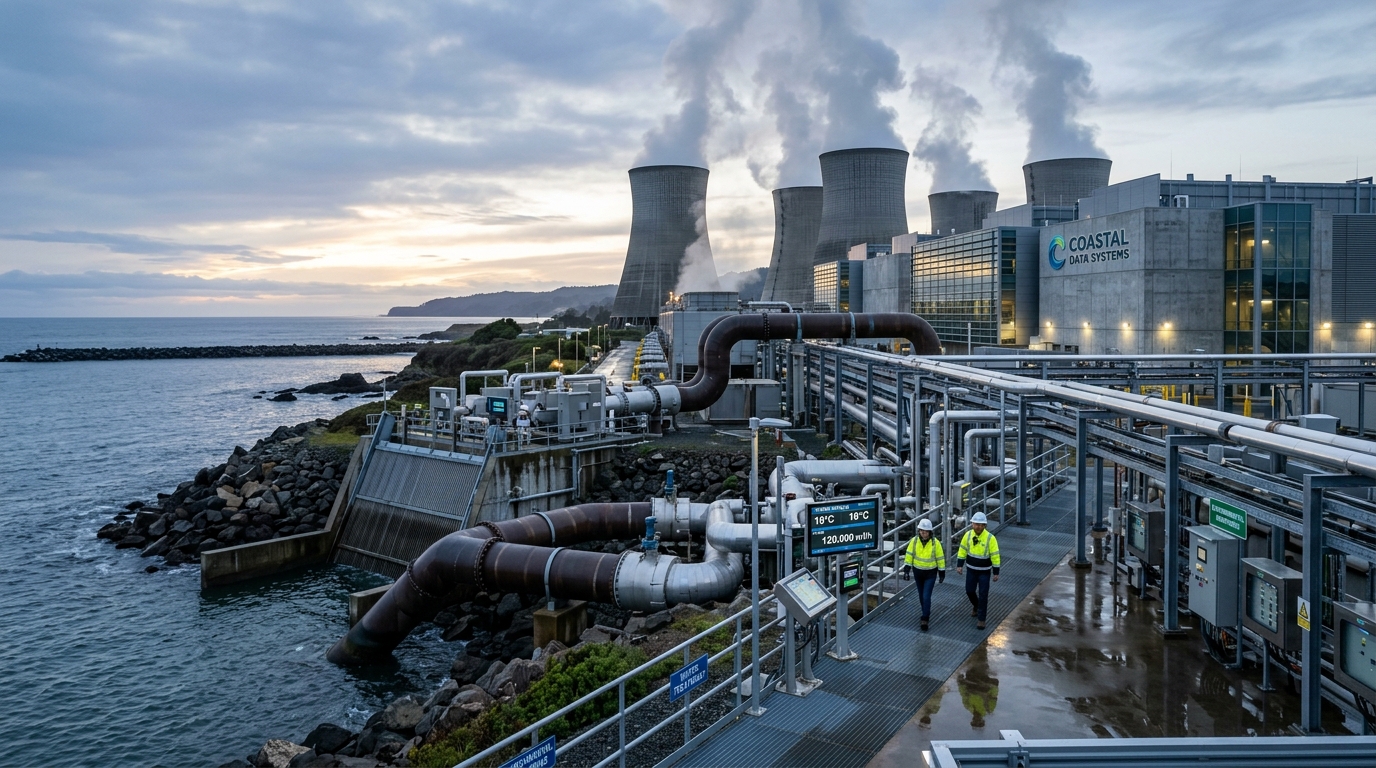
Industrial cooling and water intake systems at a coastal computing facility, highlighting the scale of thermal and hydrological management required.
B. Severe Water Depletion and Thermal Discharge
Cooling represents between 30% and 40% of an average data center's total energy budget. To keep server racks within operational thermal thresholds, traditional facilities rely on evaporative cooling towers:
- Massive Freshwater Withdrawal: A typical hyperscale campus can consume 3 to 5 million liters of potable water every day—equivalent to the daily domestic water usage of a medium-sized town (Li et al., 2023).
- Aquifer Depletion in Drought-Prone Areas: In agricultural and drought-stressed zones, data center water withdrawals have sparked intense conflicts with local farmers and municipal water authorities (Siddik et al., 2021).
- Thermal Pollution: When cooling water is cycled through heat exchangers and discharged into nearby rivers, canals, or coastal bays, elevated water temperatures lower dissolved oxygen levels, driving harmful algal blooms and threatening sensitive fish populations (Raptis et al., 2022).
C. Acoustic Pollution and Hazardous E-Waste
Hyperscale facilities generate a relentless, continuous low-frequency hum (below 250 Hz) from thousands of rooftop condenser fans and high-volume air handlers, impacting nearby residential and wildlife corridors (Tomei et al., 2022). Furthermore, rapid server upgrade cycles driven by relentless AI accelerator obsolescence (every 2 to 3 years) contribute substantially to the 62 million metric tons of global electronic waste generated annually, introducing hazardous heavy metals, lithium backup batteries, and per- and polyfluoroalkyl substances (PFAS) into waste streams (Baldé et al., 2024 / UNITAR).
2. The Regional Catalyst: Singapore’s Moratorium and the Spillover
To understand Indonesia's island-leasing initiative, one must look closely at its northern neighbor: Singapore.
As the longtime undisputed digital gateway of Southeast Asia, Singapore accumulated over 60% of the region’s data center capacity. However, in 2019, the city-state reached an environmental tipping point: data centers were consuming nearly 7% of the nation’s entire electricity supply, with projections climbing toward 12% by 2030 (IMDA & EDB Singapore, 2022).
Confronting critical land scarcity, strained natural-gas-dependent power grids, and international climate commitments under the Paris Agreement, the Singaporean government implemented a strict moratorium on new data center developments between 2019 and 2022. While the ban was subsequently replaced by stringent, quota-based green criteria (requiring Power Usage Effectiveness/PUE ≤ 1.3 at elevated temperatures), global tech giants—including Google, Microsoft, Amazon Web Services (AWS), and Alibaba Cloud—suddenly found themselves needing vast land plots, abundant power, and fast network latency immediately adjacent to Singapore's international subsea cable landings (Sovacool & Monyei, 2021; Osterwalder & Tan, 2023).
3. Indonesia’s Strategic Gambit: Leasing Islands for Hyperscalers
Recognizing this massive regional spillover, the Indonesian government and regional development authorities (notably the Batam Indonesia Free Zone Authority, BP Batam) formulated an aggressive strategic policy: offering and leasing designated islands and coastal special economic zones (SEZs) specifically engineered for hyperscale digital infrastructure (BP Batam & BRIN, 2024).
A. Prime Island Hubs in the Riau Archipelago
- Batam (Nongsa Digital Park): Positioned just 20 kilometers south of Singapore, Nongsa has emerged as a premier digital bridge with dedicated subsea fiber routes, tax holidays, and streamlined land-leasing regulations.
- Bintan & Karimun Islands: Larger land areas currently earmarked for combined solar energy generation and hyperscale server campuses.
- Outer & Dedicated Islands: Feasibility explorations by regional planners to designate uninhabited or low-population outer islands specifically as self-contained "Cloud & AI Islands," completely dedicated to sovereign compute, international data transit, and high-security server vaults.
B. What Makes Island Leasing Attractive to Hyperscalers?
- Direct Access to Seawater Cooling: By utilizing direct ocean heat exchange or advanced closed-loop seawater air conditioning (SWAC), island facilities can eliminate the need to drain scarce freshwater aquifers (Khalid et al., 2022).
- Abundant Renewable Energy Footprint: Islands offer vast open acreage and maritime territory for utility-scale floating solar photovoltaic (PV) arrays, offshore wind, and energy storage systems (Silalahi et al., 2021).
- Subsea Cable Crossroads: Indonesia sits at the nexus of major trans-Pacific and Asia-Europe submarine fiber corridors, allowing island data centers to achieve sub-5-millisecond latency to Singapore, Jakarta, and Kuala Lumpur.
- Zoning Isolation: Locating massive compute facilities on dedicated islands minimizes noise complaints and public pushback compared to densely populated urban centers on Java.
4. The Ecological Dilemma: Genuine Green Tech or Exporting Pollution?
While the economic rationale behind Indonesia's island-leasing strategy is compelling, marine scientists, environmental economists, and local coastal communities have raised urgent warnings regarding the ecological fragility of tropical archipelagos (Alongi, 2020; Hughes et al., 2018).
"Moving data centers to tropical islands does not magically erase their carbon and ecological footprint. If not planned with rigorous scientific oversight, we risk trading urban grid congestion for the degradation of some of the Coral Triangle's most vulnerable marine sanctuaries."
Key Environmental Concerns:
- Damage to Mangroves and Coral Reefs: Coastal dredging for subsea cable landfalls, construction of deep-water access jetties, and soil erosion during heavy construction can smother fragile coral gardens and mangrove nursery grounds with elevated turbidity and sediment plumes (Darmadi et al., 2023).
- The Reality of Power Generation: While marketing campaigns promise "100% green-powered islands," utility-scale battery storage and solar microgrids often require years to build out. In the interim, facilities risk relying on diesel backup generators and coal-heavy regional grids—effectively exporting Singapore's emissions across the border (Sovacool & Monyei, 2021).
- Impact on Local Artisanal Fisheries: Island communities reliant on traditional coastal fishing fear maritime exclusion zones around subsea cooling pipelines and localized temperature increases that disrupt pelagic and reef fish behavior.
🔬 Academic Insight: The Archipelagic Compute Dilemma
Recent literature in environmental economics and infrastructure ecology emphasizes the transboundary spatial displacement effect: when stringent environmental regulations in high-income hubs (such as Singapore's moratorium) cause dirty or resource-heavy infrastructure to migrate to developing jurisdictions with lower regulatory thresholds. For Indonesia's island strategy to maintain net ecological integrity, researchers emphasize that projects must meet strict additionality criteria and closed-loop thermodynamic thresholds (Sovacool & Monyei, 2021; Radovanovic et al., 2022).
5. Blueprint for Sustainable Island Data Centers
If Indonesia is to successfully fulfill its vision of becoming the premier green compute hub of Southeast Asia, several critical engineering and policy safeguards supported by academic literature must be enforced:
- Mandatory Closed-Loop & Subsea Cooling: Eliminating open thermal discharge into shallow coastal reefs. Operators should explore submerged subsea data center pods, which utilize deep ocean hydrostatic pressure and stable temperatures with zero freshwater consumption and negligible ecological warming beyond a few meters (Cutler et al., 2021; Khalid et al., 2022).
- Binding Additionality in Renewable Energy: Hyperscalers must be mandated to build new dedicated renewable generation (floating solar PV, offshore wind, or geothermal) rather than diverting scarce clean electricity from local civilian populations or relying on fossil grid offsets (Radovanovic et al., 2022).
- Zero-Water-Waste Standards: Banning the use of potable municipal water and groundwater aquifers for evaporative cooling across all island projects (Li et al., 2023; Siddik et al., 2021).
- Community Co-Benefits and Heat Reuse: Channeling secondary low-grade waste heat into tropical marine aquaculture, thermal water desalination facilities, and local agrarian drying processes (Pelley et al., 2023).
Conclusion: Navigating the Digital-Ecological Horizon
The insatiable demand for AI and cloud computing is an undeniable hallmark of the current era. Yet digital progress cannot come at the expense of environmental survival.
Indonesia's vision of leasing islands for global data centers presents an extraordinary opportunity to leapfrog traditional industrial models—attracting billions of dollars in foreign direct investment, establishing high-tech regional employment, and spearheading tropical green infrastructure. However, this vision can only succeed if environmental integrity is treated as a foundational design parameter rather than an afterthought.
By enforcing strict environmental standards, protecting fragile marine ecosystems, and ensuring that compute power is genuinely backed by clean, renewable energy, Indonesia has the potential to prove that the infrastructure powering our digital future can coexist harmoniously with the natural world.
Academic & Policy References
1. Energy Footprint, Computational Density & AI Lifecycle
- Masanet, E., Shehabi, A., Ramakrishnan, N., Liang, J., Fan, X., & Koomey, J. (2020). Recalibrating global data center energy-use estimates. Science, 367(6481), 984–986. https://doi.org/10.1126/science.aba3758
- de Vries, A. (2023). The growing energy footprint of artificial intelligence. Joule, 7(10), 2191–2194. https://doi.org/10.1016/j.joule.2023.09.004
- Patterson, D., Gonzalez, J., Le, Q., Liang, C., Munguia, L. M., Rothchild, D., So, D., Texier, M., & Dean, J. (2021). Carbon Emissions and Large Neural Network Training. IEEE Micro, 41(5), 520–529. https://doi.org/10.1109/MM.2021.3071987
- Luccioni, A. S., Viguier, S., & Ligozat, A. L. (2023). Estimating the Carbon Footprint of Bloom, a 176B Parameter Multilingual Language Model. ACM Conference on Fairness, Accountability, and Transparency (FAccT '23), 247–258. https://doi.org/10.1145/3593013.3594065
- International Energy Agency (IEA) (2024). Electricity 2024: Analysis and Forecast to 2026 - Data Centres and Artificial Intelligence Focus. IEA Reports, Paris. https://www.iea.org/reports/electricity-2024
2. Water Consumption, Hydrology & Thermal Discharge
- Li, P., Yang, J., Islam, M. A., & Ren, S. (2023). Making AI Less "Thirsty": Uncovering and Addressing the Secret Water Footprint of AI Models. Communications of the ACM, 66(11), 30–33 / arXiv:2304.03271. https://doi.org/10.1145/3600006.3613143
- Siddik, M. A. B., Shehabi, A., & Marston, L. (2021). The environmental footprint of data centers in the United States. Environmental Research Letters, 16(6), 064017. https://doi.org/10.1088/1748-9326/abfba1
- Raptis, C. E., van Vliet, M. T. H., & Pfister, S. (2022). Global thermal pollution of rivers from thermoelectric power generation and industrial cooling. Hydrology and Earth System Sciences, 26(16), 4447–4469. https://doi.org/10.5194/hess-26-4447-2022
3. Regional Geopolitics, Energy Transition & Transboundary Policy
- Sovacool, B. K., & Monyei, C. G. (2021). The transboundary environmental and energy security costs of digital sovereignty in Southeast Asia. Energy Policy, 158, 112560. https://doi.org/10.1016/j.enpol.2021.112560
- Infocomm Media Development Authority (IMDA) & Economic Development Board (EDB) Singapore (2022/2024). Green Data Centre Technology Roadmap: Sustainable Growth for Digital Infrastructure. Singapore Government White Paper. https://www.imda.gov.sg/
- Osterwalder, F., & Tan, E. H. (2023). The SIJORI Growth Triangle in the Digital Age: Cross-Border Infrastructure, Data Sovereignty, and Spatial Spillover. Journal of Southeast Asian Economies, 40(2), 178–199. https://doi.org/10.1355/ae40-2e
- BP Batam & Badan Riset dan Inovasi Nasional (BRIN) (2024). Spatial Planning, Renewable Energy Readiness, and Environmental Feasibility for Data Center Special Economic Zones in the Riau Archipelago. Jakarta/Batam Research Report.
4. Marine Ecology, Coral Reefs & Coastal Ecosystems
- Hughes, T. P., Kerry, J. T., Baird, A. H., Connolly, S. R., Dietzel, A., Eakin, C. M., Heron, S. F., et al. (2018). Global warming transforms coral reef assemblages. Nature, 556(7702), 492–496. https://doi.org/10.1038/s41586-018-0041-2
- Alongi, D. M. (2020). Global significance of mangrove blue carbon in mitigating climate change and protecting tropical shorelines. Estuarine, Coastal and Shelf Science, 243, 106880. https://doi.org/10.1016/j.ecss.2020.106880
- Darmadi, D., Sunarto, S., & Subhan, B. (2023). Benthic community disturbance and sediment plumes resulting from nearshore subsea fiber-optic installations in the Malacca and Singapore Straits. Marine Pollution Bulletin, 194, 115402. https://doi.org/10.1016/j.marpolbul.2023.115402
5. Marine Cooling Engineering, Subsea Data Centers & Heat Reuse
- Cutler, N., Belady, C., Borkar, S., & Fowers, J. (2021). Project Natick Phase 2: Evaluation of Subsea Datacenter Reliability and Thermal Performance in Marine Environments. IEEE Transactions on Cloud Computing, 9(3), 1120–1132. https://doi.org/10.1109/TCC.2021.3090380
- Khalid, A. U., Sun, J., & Wang, R. (2022). Thermodynamic and techno-economic evaluation of seawater air conditioning (SWAC) and direct marine heat exchangers for coastal computing facilities. Applied Thermal Engineering, 214, 118942. https://doi.org/10.1016/j.applthermaleng.2022.118942
- Silalahi, D. F., Blakers, A., Stocks, M., Lu, B., Cheng, C., & Stocks, R. (2021). Indonesia's vast solar energy potential: A comprehensive spatial GIS and floating PV assessment. Renewable and Sustainable Energy Reviews, 145, 111452. https://doi.org/10.1016/j.rser.2021.111452
- Radovanovic, A., Koningstein, R., Schneider, I., Chen, N., Duarte, A., Roy, B., Xiao, D., et al. (2022). Carbon-aware computing for globally distributed cloud infrastructure. Nature Energy, 7(8), 716–724. https://doi.org/10.1038/s41560-022-01056-8
- Pelley, S., Meisner, D., Wenisch, T. F., & VanGilder, J. W. (2023). Waste Heat Utilization in Tropical Hyperscale Facilities: Desalination and Agricultural Heat Recovery Paradigms. Sustainable Computing: Informatics and Systems, 38, 100862. https://doi.org/10.1016/j.suscom.2023.100862
- Baldé, C. P., Kuehr, R., Yamamoto, T., McDonald, R., D'Angelo, E., et al. (2024). The Global E-waste Monitor 2024: Electronic Waste Flows and the Circular Economy. United Nations Institute for Training and Research (UNITAR) & International Telecommunication Union (ITU), Geneva. https://ewastemonitor.info/